
Door and hardware assessment
The door should be checked for balance, smooth travel, secure tracks and compatible spring hardware before the operator is attached.
Serving Okeechobee, Florida & surrounding areas
Opener service in Okeechobee
Get an opener matched to your door, installed with properly positioned safety sensors, programmed controls and a complete operating check.
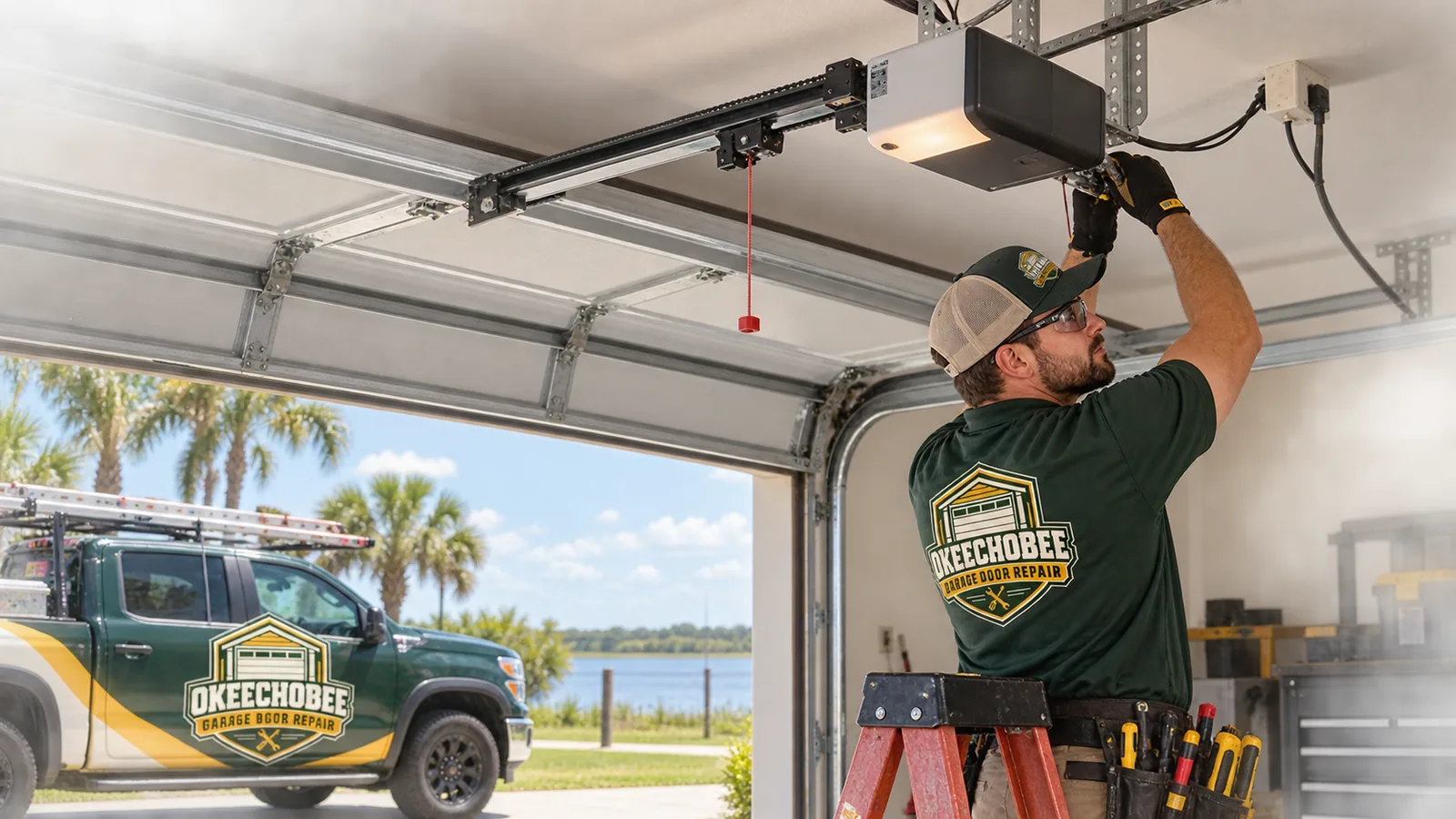
The door comes first
Garage door opener installation in Okeechobee, FL starts with the door itself. Its size, weight, balance, track condition and available ceiling clearance all affect which opener and rail configuration will work. Okeechobee Garage Door Repair evaluates those conditions before installation rather than choosing equipment by horsepower alone.
An opener moves the door, but the door's spring system carries the load. A technician should be able to disconnect the trolley and confirm that the door moves smoothly by hand and remains reasonably balanced. Installing a stronger motor does not correct broken springs, binding rollers, bent track or a poorly balanced door. Those conditions can strain a new operator and should be identified before setup.
Local garages also contend with Florida heat, humidity and frequent thunderstorms. Equipment should be mounted securely, low-voltage wiring should be routed away from moving parts, and controls should be tested after setup. For broader problems involving the door, tracks or springs, garage door repair in Okeechobee can address the mechanical issue before it damages a new opener.
Compare opener options
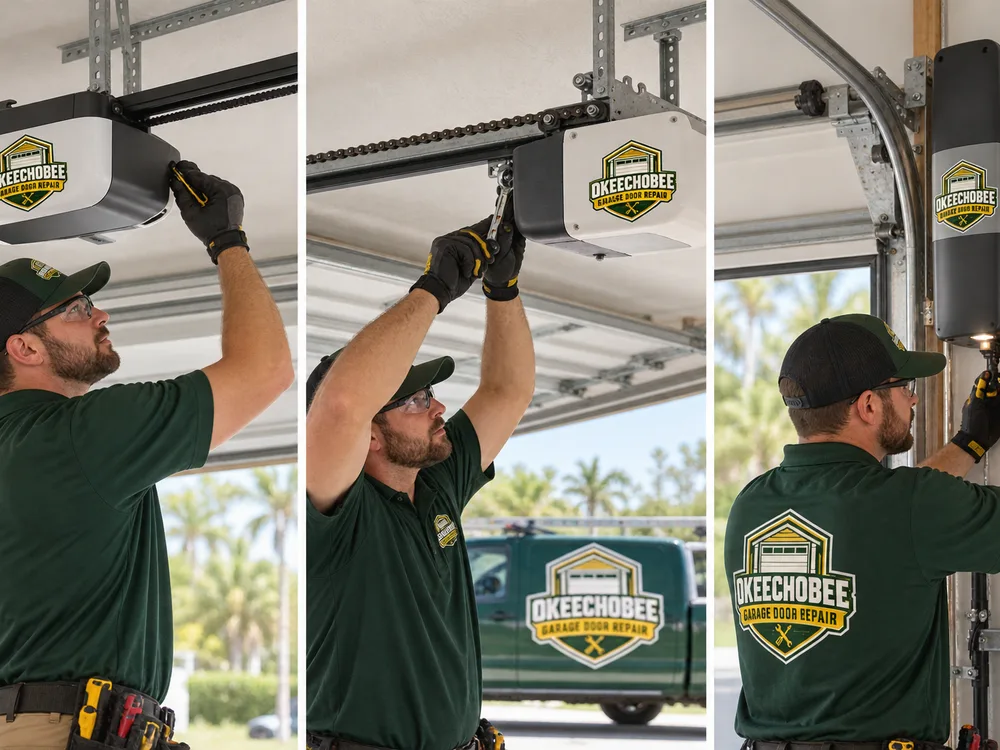
Belt-drive openers are a common choice when quieter operation matters, especially when living space is close to the garage. Chain-drive units are durable and may suit a detached garage where some operating noise is less important. A wall-mount operator can free overhead space, but it requires a compatible torsion-shaft arrangement and adequate side clearance. It is not suitable for every door.
Motor rating is only one part of selection. Door height determines rail length, while door construction and weight affect the operator choice. Battery backup, exterior keypads, vehicle remotes and app-connected controls may be available depending on the selected model. Smart features also depend on compatible equipment and a usable Wi-Fi signal in the garage.
Okeechobee Garage Door Repair can compare opener options without treating every garage as the same. The goal is an opener that fits the existing door and the way the household uses it.
Complete installation scope
The door should be checked for balance, smooth travel, secure tracks and compatible spring hardware before the operator is attached.
The motor head, rail, header bracket and door arm must be positioned for the door's travel and fastened to suitable framing.
Photo-eye sensors belong near the floor on opposite sides of the opening. Both must face each other and remain clear of the door's path.
Open and close limits are adjusted so the door reaches the correct positions without driving hard into the stop points.
Compatible remotes, wall controls and keypads are paired and tested. Optional connected controls are configured when included with the equipment.
The installer tests photo-eye reversal, closing response, manual release operation and the door's full travel before completing the work.
From inspection to final test
Okeechobee Garage Door Repair checks the door's movement, balance, track condition, spring setup, ceiling clearance and nearby power access. Existing equipment is also reviewed when the job involves replacement.
The opener type, rail length, controls and compatible accessories are matched to the door. Any mechanical issue that should be corrected first is identified before installation begins.
The rail, motor unit, header bracket, door arm, wall control and photo-eye sensors are mounted and connected. Wiring is secured away from rollers, hinges and other moving hardware.
Travel limits and operating force are set for the specific door. Included remotes and keypads are programmed, and compatible smart controls are connected when requested.
The door is cycled through full opening and closing. Safety reversal, sensor response and the emergency release are checked, and the customer receives basic operating guidance.
Diagnose before replacing
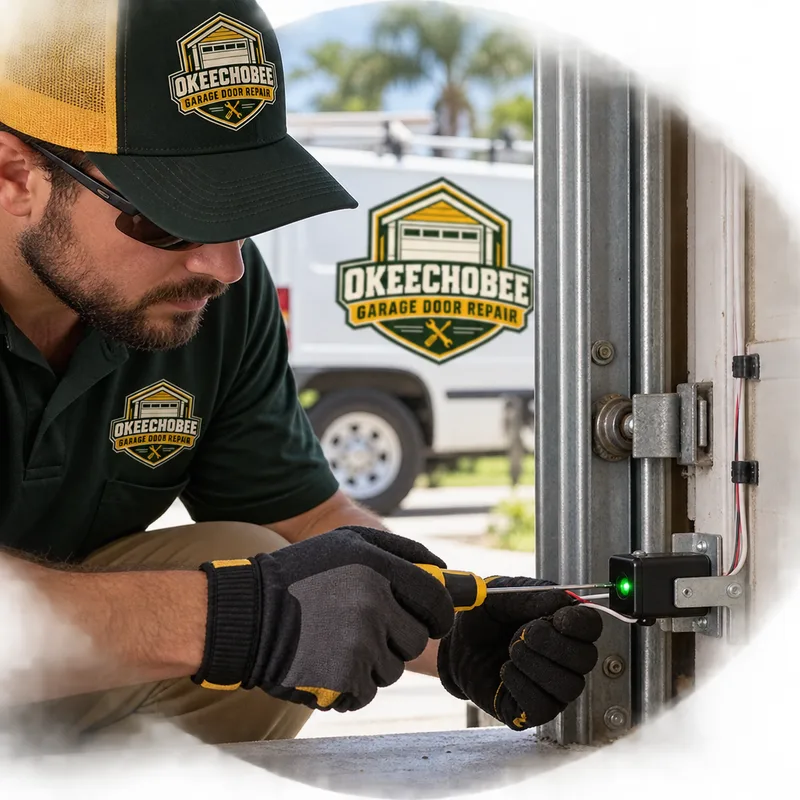
A failed opener does not always require replacement. Garage door opener repair in Okeechobee, FL may be appropriate when the unit has a correctable sensor, control, wiring, carriage or adjustment problem and the needed parts are compatible with the model.
Common symptoms include a motor that runs while the door does not move, a door that reverses near the floor, intermittent remote response, grinding from the rail or a trolley that no longer engages. A blinking opener light can also indicate a sensor or diagnostic fault, depending on the model. Sun glare, dirty sensor lenses and misalignment can disrupt photo eyes, but repeated reversal may also point to door resistance or incorrect travel settings.
Replacement may make more sense when a unit has extensive internal wear, unavailable parts, repeated failures or controls that no longer meet the household's needs. The door should still be inspected independently. If it is difficult to lift after using the emergency release, stop operating it and arrange an assessment rather than relying on the motor to pull harder.
Safe operation in local conditions
Federal safety standards require residential garage door openers made since 1993 to use an external entrapment-protection system, commonly photo-eye sensors near the bottom of the opening. Those sensors should never be mounted out of position or bypassed. The opener's mechanical reversal response and manual release also need to work as intended.
Florida thunderstorms can interrupt power and expose plugged-in equipment to electrical surges. A battery-backup model can allow limited powered operation during an outage, but capacity and operation vary by model. Surge protection may reduce some electrical risk, although it cannot prevent every type of storm-related damage. After a nearby lightning event or outage, unusual behavior should be diagnosed before the opener is cycled repeatedly.
Keep storage, yard equipment and debris away from the sensor beam. Check the emergency release instructions before an outage occurs, and use care when releasing a closed door. A door with a broken spring can be unexpectedly heavy. Never pull the release while standing in the door's path or while an unsupported door is open.
Opener problems may come from the controls, sensors, wiring, rail, or the door itself. An inspection shows which part needs attention.
Answers before opener service
Customer-supplied equipment may be installable if it is complete and compatible with the door. The opener must match the door height, weight, spring arrangement and available mounting space. Wall-mount operators have additional torsion-shaft and side-clearance requirements, so compatibility should be checked before installation begins.
Repair is often reasonable when the fault is isolated and compatible parts remain available; replacement is usually more practical for extensive wear, recurring failures or obsolete controls. The door's condition matters too. A binding or unbalanced door must be corrected regardless of which opener is used.
No, a new opener should not be used to compensate for a heavy or unbalanced door. The springs are responsible for counterbalancing the door, while the opener guides its movement. If the door is difficult to lift manually after disconnection, its spring system or hardware needs professional attention.
Battery backup is optional, but it can be useful during the power interruptions associated with Florida thunderstorms. It provides a limited number of powered cycles depending on the model, battery condition and door. Every installation should still have an accessible manual release and clear instructions for safe use.
A door that closes and reverses may have blocked or misaligned photo eyes, incorrect travel settings, resistance in the tracks or a mechanical door problem. Clean both sensor lenses and remove objects from the opening, but do not bypass the sensors. Persistent reversal calls for diagnosis of both the opener and the door.
They can work only if their radio technology and programming method are compatible with the new opener. Older remotes may not pair with current equipment, while vehicle-integrated controls sometimes require an additional compatibility device. The controls should be identified before deciding which ones can be reused.
A compatible smart opener can use the home's Wi-Fi if the signal reaches the garage and meets the manufacturer's network requirements. Masonry walls, distance from the router and metal surfaces can weaken coverage. App access should be tested during setup rather than assumed from coverage inside the house.
Tell Okeechobee Garage Door Repair what the door is doing and which controls matter to your household. A proper assessment will identify compatible equipment, needed adjustments and the work required for safe operation.